A count on its own can mislead. SSH Intel wraps every number in the context that makes it honest. Five ideas cover almost everything you will see.
Counts versus rates
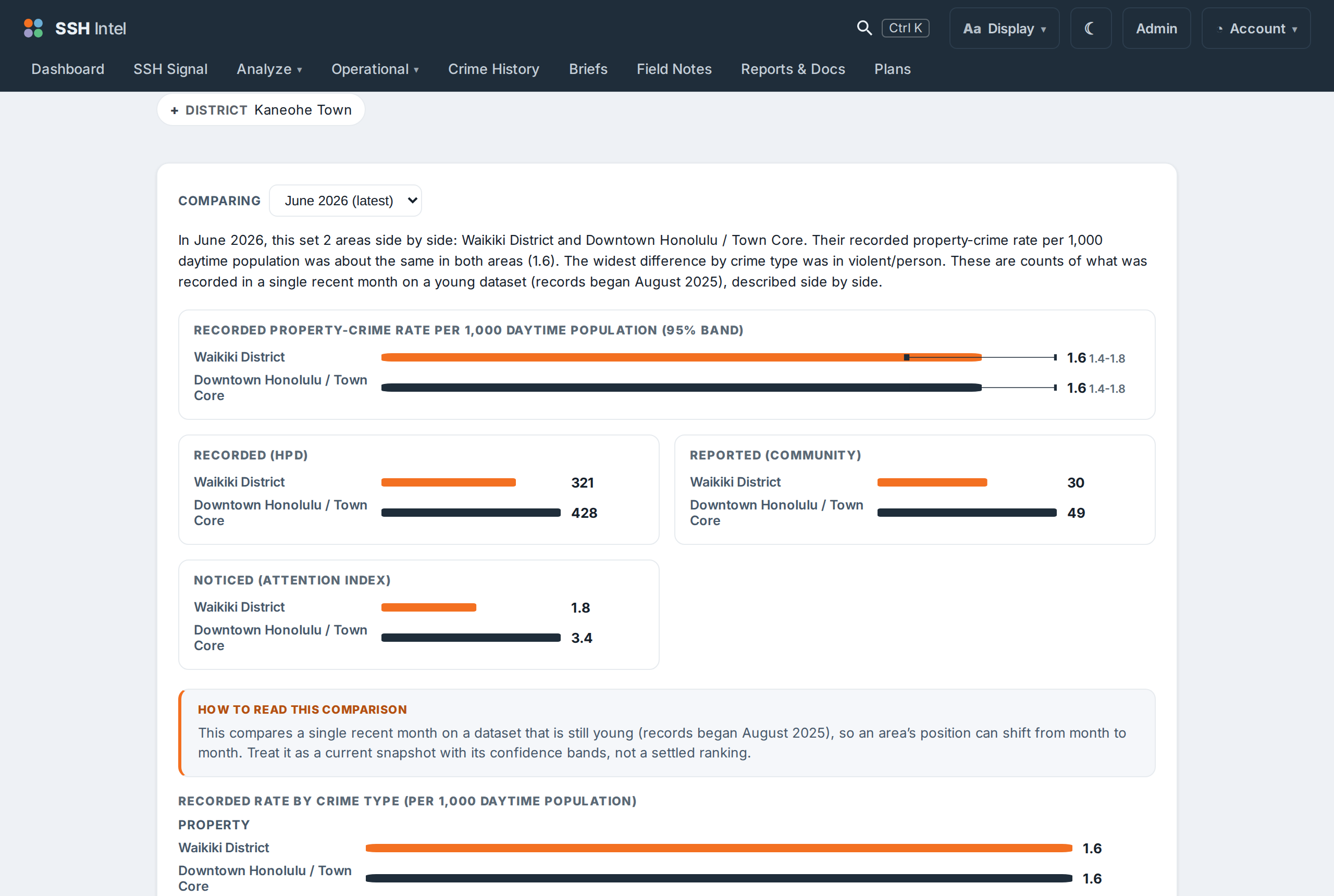
A count is how many were recorded. A rate is that count divided by how many people are around, expressed as "per 1,000." Rates let you compare a busy district with a quiet one fairly. A big downtown will always have a higher count and may still have a lower rate.
The daytime denominator
We divide by daytime population, residents plus the workers and visitors actually present by day, not residents alone. Commercial and tourist areas fill up during the day; dividing by residents alone would overstate their rates several times over. Using the population that is really there is the fair denominator.
Confidence bands
Every rate carries a 95% confidence band: the range the true rate is statistically consistent with. Smaller areas and smaller counts get wider bands. When two areas' bands overlap heavily, treat them as "about the same," not as one being clearly higher.
Small counts are withheld where they could identify someone
Counts in groups that involve people are withheld when small: under 10 for groups that could identify a victim (such as sex offenses or missing persons), under 5 for other person-linked groups (such as assault or drugs), and under 5 for any total that mixes people and property. Property and event counts (a stolen bike, a lost dog) print in full. When one cell is withheld, a few others may be too, so it cannot be worked out by subtraction. This is why a very specific search in a small area sometimes returns a withheld figure instead of a number. That is privacy protection, not missing data. See Why did my search decline.
Provisional and settling
The most recent month is always the least complete. Police records trickle in for about a month, so the latest month is tagged Provisional; past provisional months have settled upward as late records arrived. A low newest-month number is usually "not counted yet," not "did not happen." See Why did the number change.
Last updated 2026-07-15 HST