The most important thing to know about SSH Intel is what it refuses to do. It describes what was recorded. It never predicts, scores, grades, ranks places, or tells you whether somewhere is "safe."
The line we hold
Past-tense description is allowed: "142 thefts were recorded here last quarter," "the rate ran about twice the Oahu average," "activity eased over recent months." A verdict or a forecast is not: no "high-risk area," no "Grade D," no "this will rise," no "safe" or "dangerous." The difference is a single change in grammar, from describing to judging, and we stay on the describing side of it.
Why, as a principle
A neighborhood is not a number. Turning a place into a letter grade stigmatizes the people who live and work there, and it launders a confounded statistic into a moral judgment. A "high-crime" label often just means "more daytime visitors" or "more people who bother to report." We would rather hand you the honest, sourced facts and let you draw your own conclusion.
Why, as protection
Describing public-record facts is strongly protected. Predicting or advising induces reliance and jumps into a different, heavier category of liability, the same territory that has caught tenant-screening scores under fair-housing law. By never scoring or ranking, we protect both you and us. The full reasoning is in the methodology.
What this means for you
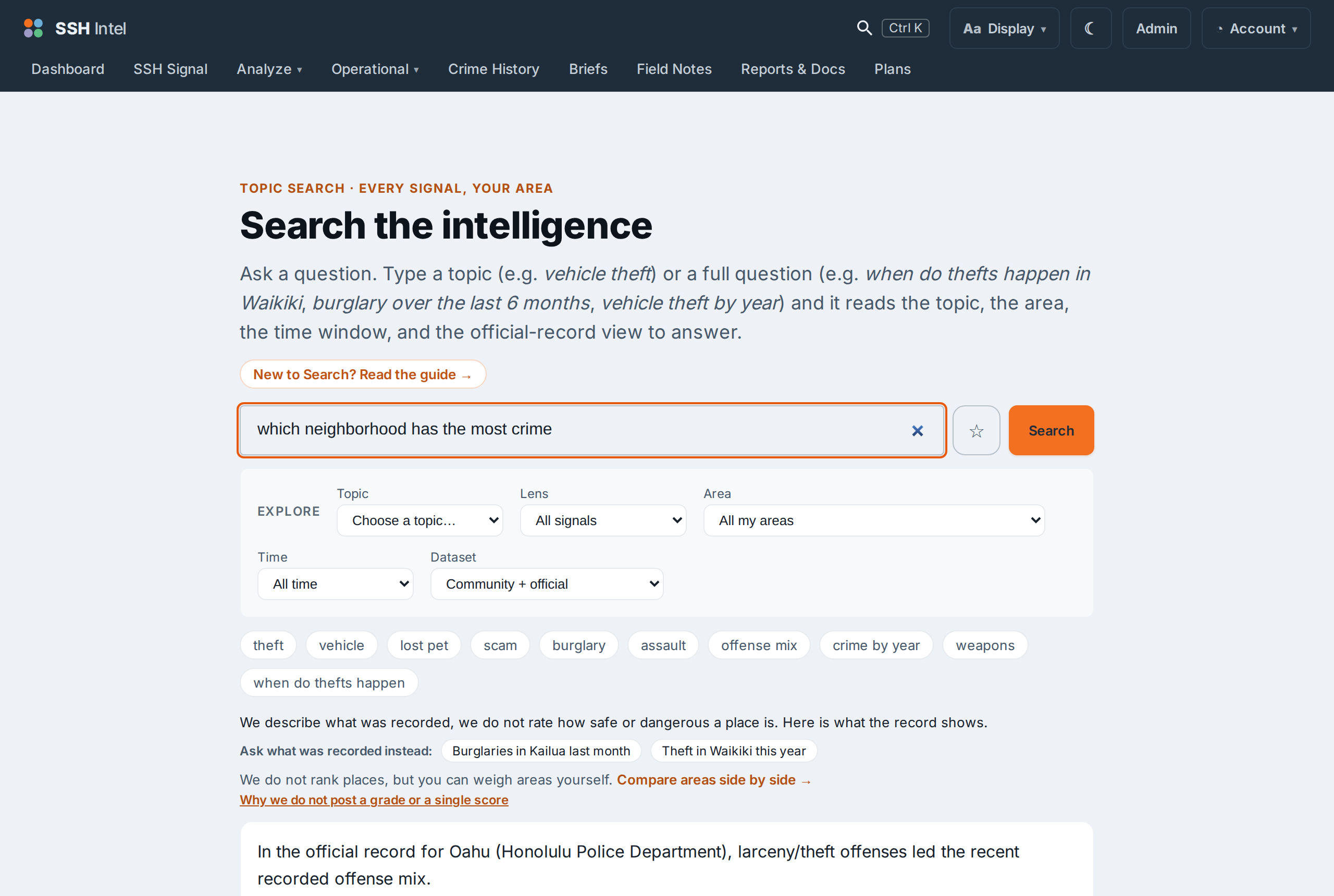
If you ask the tool "is Waikiki safe" or "rank my areas by danger," it will politely decline and offer to show you the descriptive facts instead. That is the product working as designed, not a bug. See Why did my search decline.
Last updated 2026-07-15 HST